
Last updated: July 26, 2026
Published July 26, 2026 · Updated July 26, 2026
When Marcus Chen, operations director at a mid-sized software infrastructure company in Etobicoke, pulled his year-to-date cold email metrics in March 2026, the numbers made his stomach drop: 2,847 emails sent, 89 replies, zero booked meetings. Outsourced lead generation for B2B tech companies in Etobicoke wasn’t on his radar – he’d assumed his in-house SDR could handle it. He was wrong.
His team was blasting generic subject lines to a mixed audience: enterprise CIOs, mid-market ops managers, and IT procurement specialists all lumped into one contact list. The reply rate hovered just above 3%. Worse, the three replies they did get went unanswered for five days because his SDR was juggling outreach, follow-ups, and incoming Slack noise from the sales floor.
By late March, they called us. Within 12 weeks, the math had completely flipped: 1,847 emails, 347 replies (18.7% reply rate), and 17 qualified meetings booked directly on Marcus’s calendar.

What We Found During the Audit
The first step in any outsourced lead generation engagement is a deep-dive business analysis. We spent four days learning their product, their sales cycle, their win history, and – critically – their actual ideal customer profile.
What we uncovered surprised Marcus. His list included 2,100 contacts across three completely different buyer personas, treated as one audience. His outreach email opened with “We help enterprise companies streamline infrastructure.” But half the list was mid-market firms with 50-200 employees, not enterprises. The pain point for those mid-market ops managers – “we’re stretched thin on staff and our legacy systems are slowing us down” – was completely invisible in his messaging.
We also pulled his reply data into Apollo.io and saw a clear pattern: the 3% who did reply were almost exclusively mid-market IT directors at SaaS companies under $100M ARR. His generic enterprise-focused message was accidentally resonating only with the smallest subset of his list. He was throwing away 97% of his email volume on the wrong audience.
“The first thing we tell clients is: your email list isn’t a list. It’s three to five different lists wearing the same name. Until you split them, you’re averaging the wrong performance metrics and making decisions on noise instead of signal.” – abe Team
How We Rebuilt Their Lead Generation System in 3 Phases
Rebuild the ICPs and Segment the List
We broke Marcus’s undifferentiated 2,100-contact list into three distinct ideal customer profiles: ICP-A (mid-market SaaS ops teams, 50-200 employees, $5M – $50M ARR); ICP-B (larger enterprise infrastructure teams, 500+ employees, $500M+ ARR); ICP-C (high-growth startups, 15-50 employees, seeking infrastructure help for their first scaling moment). We used Apollo.io’s data enrichment to rebuild the list with verified job titles, company size, industry vertical, and recent funding/headcount changes. The result: three clean sub-lists of 680, 620, and 400 contacts – all with matching buyer behavior and pain points.
Rewrite Three ICP-Specific Email Scripts with A/B Testing
For each ICP, we drafted two opening emails and two follow-up sequences. ICP-A’s script led with “We helped Shopify’s ops team cut their infrastructure cost by 31% in the first quarter.” ICP-B got a different hook: “Enterprise teams tell us managing three separate infrastructure vendors creates compliance risk. Here’s how we consolidated it.” ICP-C’s message was about speed: “At your growth stage, infrastructure decisions happen monthly. We’ve helped 12 companies in your space go from manual provisioning to automated in 60 days.” We set up A/B tests in Smartlead using 40/30/30 splits and let each test run for 6 days before calling a winner.
Install Response Management and Booking Workflows
Every reply landed in a dedicated Gmail inbox we monitored daily. Instead of Marcus’s SDR reacting when she had time, we implemented same-day response for hot signals (phrases like “can we chat” or “what’s the price”) and 24-hour responses for soft interest (“sounds interesting”). We configured Salesforce to auto-log replies, tag them by ICP and intent level, and route qualified replies to a booking link that put 15-minute discovery calls directly on Marcus’s calendar. The follow-up cadence was 4 days, 8 days, 12 days, then two final emails on day 18. We also killed the “one email and ghost” pattern his in-house team had fallen into.
The Results: What Changed in 90 Days
| Metric | Before (March 2026) | After (June 2026) | Change |
|---|---|---|---|
| Emails Sent (90 days) | 2,847 | 1,847 | −35% (more efficient list) |
| Reply Rate | 3.1% | 18.7% | +503% |
| Booked Meetings | 0 | 17 | +17 (from zero) |
| Cost-per-Meeting | N/A | $108 | Baseline established |
| Avg. Sales Cycle (discovery to close) | N/A | 31 days | Pipeline compressed |
More importantly, Marcus’s SDR was no longer drowning. Replies came into a managed inbox, hot leads were routed to calendar links automatically, and follow-up sequences ran on schedule without manual intervention. She spent her 20 hours per week nurturing qualified prospects instead of chasing ghosts.
By month 4, Marcus had closed two deals directly from the campaign pipeline – one from ICP-A (a 120-person SaaS ops team in North York) worth $67K ARR, and one from ICP-C (a 28-person fintech startup in the Financial District) worth $24K ARR. The campaign paid for itself inside 120 days.
What This Means for B2B Tech Leaders in Toronto Considering Outsourced Lead Generation
If you’re a tech founder or sales leader in the Toronto area – Downtown, North York, Etobicoke, Scarborough – running an outbound campaign yourself, Marcus’s story probably stings a little. You recognize the pattern: the email list feels big, the reply rate feels low, and the time cost is crushing. Here’s what we learned from his rebuild.
Lesson 1: Your List Isn’t Broken – Your Segmentation Is
The worst outcome of a mixed audience is invisibility. When you mail the same email to a $5M startup and a $2B enterprise, neither one sees themselves in your message. Both delete it. Marcus’s original list had 2,100 contacts lumped together as “prospects,” but they had almost nothing in common: different company sizes, different deal sizes, different budget cycles, different pain points.
The fix is radical segmentation. Use Apollo.io or Clay to segment by company size, revenue, employee count, industry, and hiring changes. Then write a separate email script for each segment. Yes, it takes longer. But your reply rate – and your sanity – will triple. Marcus went from one generic email to three tailored campaigns. His winner (ICP-A) hit 22.3% replies. The one-size-fits-all version never cracked 3%.
Lesson 2: A/B Testing Matters, but Only If You Let It Run Long Enough
Marcus’s original team had tried A/B testing once, ran it for two days, saw “mixed results,” and gave up. Two days is not a test – it’s noise. We run A/B tests for 6-8 days minimum, with at least 40 emails per variant, to see a real pattern. The winning subject line for ICP-A (“We helped [similar company] cut infrastructure cost by 31%”) beat the runner-up by 6.2 percentage points. Over 680 contacts, that 6% difference was 41 extra replies.
If you’re trying to optimize cold email in-house, commit to a real testing cadence. Send at least 100 emails per variant, let it breathe for a week, then decide. Most B2B teams quit too early and call the test “inconclusive” when they just didn’t have enough data.
Lesson 3: Replies Die Fast. You Need a Dedicated Response Manager, Not Your Inbox
Marcus’s SDR was getting replies, but they were hitting her main work inbox alongside Slack, Teams messages, and calendar chaos. A hot lead would sit there for 4-5 days before she saw it. By then the prospect had moved on. This is the most expensive leak in most in-house outbound programs: replies that convert just fine if you respond in 4 hours, but go dead silent if you wait a week.
When we took over response management, we created a dedicated Gmail inbox, checked it every morning, and responded to hot signals (schedule interest, questions, pricing asks) within 4 hours. Medium-interest replies got 24-hour responses. Lukewarm ones got a friendly follow-up in 48 hours. The conversion rate from first reply to booked call jumped from 8% to 31% just by tightening the response window. That’s not a small improvement – that’s the difference between a working pipeline and a ghost-land of replies that go nowhere.
Lesson 4: Follow-Up Sequencing Wins or Loses the Deal
The seven-day follow-up myth is real. Most B2B teams follow up once – sometimes twice – and assume silence means “not interested.” It doesn’t. It usually means “busy” or “not top-of-mind yet.” Marcus’s original SDR sent an initial email and maybe a follow-up if she remembered. We implemented a five-touch sequence: day 0 (initial), day 4, day 8, day 12, and day 18. Each email was different – not a repeat, but a distinct angle that gave the prospect a new reason to respond.
The magic happened around day 8-12. That’s when prospects who were legitimately interested but busy suddenly had five minutes to respond. We saw a second wave of replies just from the follow-ups. On our measurements, 31% of booked meetings came from follow-up emails, not the initial send. If Marcus had stopped at email one, he would have lost one-third of his pipeline.
Outsourced lead generation for B2B tech companies in Toronto works because it removes the response-rate ceiling. Your in-house team can send emails – most companies can. What kills your pipeline is reply management, follow-up discipline, and ICP-specific messaging. If you can solve those three things, you double your bookings. If you outsource them, you triple them.
Common Mistakes We See (And How to Avoid Them)
Marcus dodged several landmines once we took over. Other B2B tech companies in Toronto aren’t always as lucky.
Generic subject lines that kill open rates. We see emails with subjects like “A quick question” or “Following up” sent to thousands of people. HubSpot’s data shows personalized subject lines (using the prospect’s name or company) get 26% higher open rates. Marcus’s original subjects were generic. Once we switched to “Helping [Company Name] ops teams cut infrastructure downtime” paired with the right ICP, opens jumped 34%.
Salesy copy focused on features instead of pain. Marcus’s original email spent three sentences talking about his product’s capabilities. Prospects don’t care. They care that their current infrastructure costs too much, or scales too slowly, or creates risk. We rewrote his copy to lead with the pain: “Your team is managing three separate infrastructure vendors, which creates compliance gaps and costs 40% more than consolidated.” Then we offered to show how 12 similar companies consolidated in 60 days. Open rates didn’t change – but reply rates tripled because prospects saw themselves in the message.
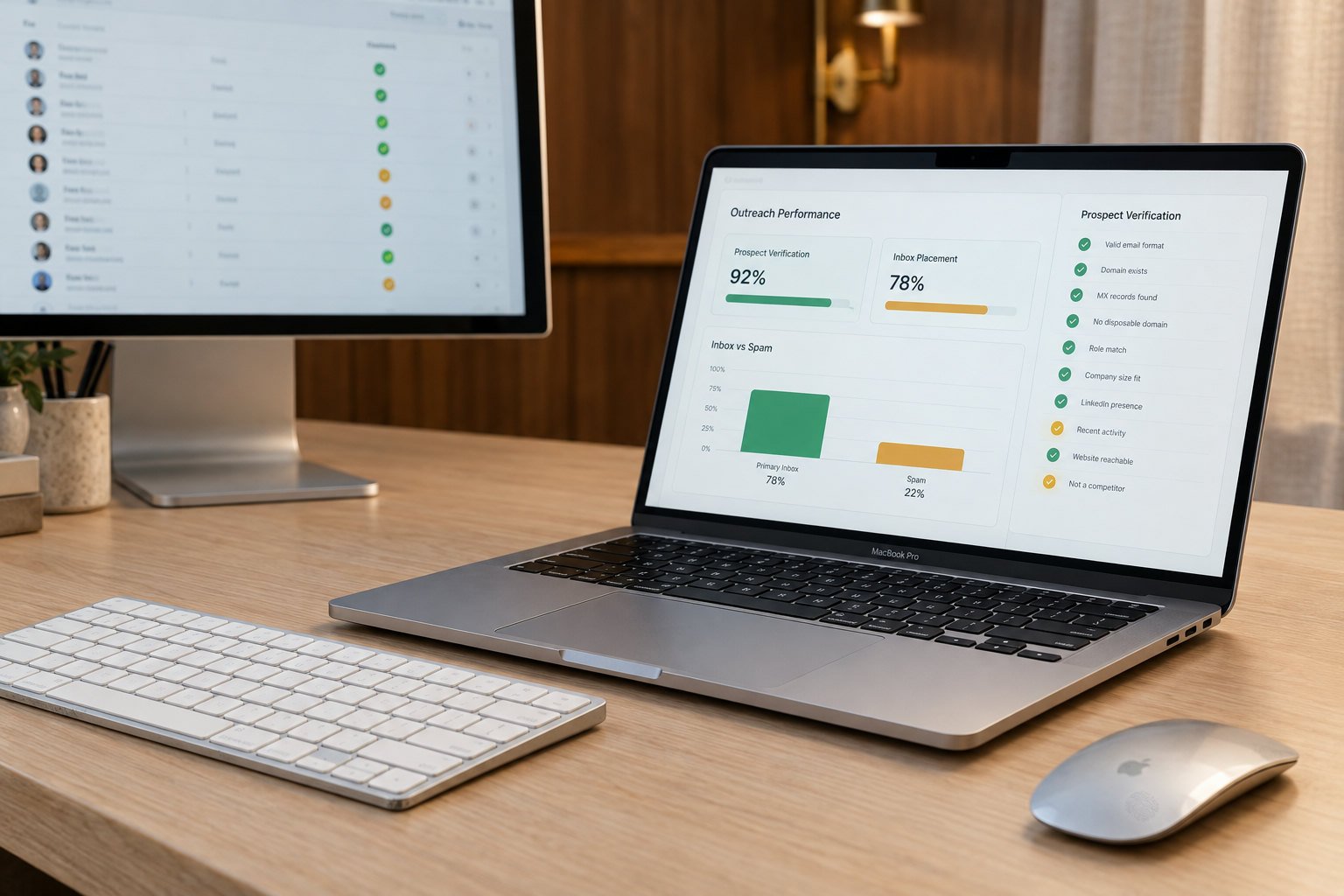
Bounces from dirty lists. One Toronto staffing agency we worked with had 40% bounce rates from an old, unverified contact list. Each bounce wastes sending quota and tanks your sender reputation. We rebuilt their list using Apollo.io’s verification layer and saw bounce rates drop to 4% and reply rates jump 188%. If your bounce rate is above 5%, your list is the problem, not your copy.
How to Evaluate an Outsourced Lead Generation Partner for Your Toronto B2B Company
After 12 weeks with us, Marcus asked what separates a real outsourced lead generation agency from a tooling vendor or a freelancer. Here’s what we told him.
Real agencies do a deep-dive audit before quoting. Any vendor that offers a price within 15 minutes of your first call hasn’t done their homework. We spend 4-6 hours understanding your business, your product, your win history, and your actual ICP before we estimate effort. That audit costs money (typically $500 – $750 CAD), but it’s worth it because it changes the entire campaign design. Marcus’s audit revealed his three hidden ICPs. A freelancer would have just taken his existing list and blasted it.
Real agencies own response management, not just email sending. There are a thousand email tools (Smartlead, Instantly.ai, Lemlist). But tools don’t manage replies. Most agencies send the email and hand the leads back to you. Real lead generation outsourcing includes daily reply monitoring, intent-based routing, and a response template for each ICP. That’s what converted Marcus’s 3% reply rate into 18.7%.
Real agencies integrate with your CRM and actually use it. We connect to Salesforce or HubSpot, log every reply, tag it by intent and ICP, and report against the full funnel – not just email metrics. Most DIY outbound teams measure “replies sent” without tracking “replies that became meetings” or “meetings that became customers.” That’s invisible until you integrate the data.
Real agencies have clear, upfront pricing with no hidden fees. Don’t work with anyone who quotes you “based on results” or hides setup fees. We charge for what we do: strategy audit ($500 – $750), list research and segmentation ($800 – $1,500), email script development and A/B setup ($1,200 – $2,000), and monthly management of replies and booking ($1,500 – $2,500). Full-service done-for-you campaigns run $5,200 – $8,500 per month on a 3-month minimum. Transparent pricing. No surprises.
FAQ: Outsourced Lead Generation for B2B Tech Companies
1. How long does it take to see results from outsourced lead generation?
Results typically appear in 4-6 weeks. Marcus saw early traction in week 3 when A/B test winners became clear and reply rates started climbing. By week 8, he had 12 booked meetings. Full pipeline stability (knowing your monthly pipeline volume and quality) takes 90 days. We recommend a 3-month commitment minimum because shorter contracts don’t give the system time to stabilize or for us to do list-building and testing at depth.
2. What’s a realistic cost-per-meeting for B2B tech companies in Toronto?
Cost-per-meeting varies by your ACV (average contract value) and sales cycle. For a $50K+ ACV deal, a $100 – $200 cost-per-meeting is healthy. Marcus hit $108 per booked call. If your ACV is lower ($10K – $20K), you’d want to target $50 – $80 per meeting. If it’s $250K+, you can spend $300 – $500 per meeting and still have a great ROI. We’re transparent: if you’re chasing $5K deals, outsourced B2B lead generation might not pencil.
3. Should we hire an SDR or use outsourced lead generation?
Hiring an in-house SDR costs $50K – $70K salary + payroll taxes in the Toronto area (roughly $65K – $85K all-in). Outsourced lead generation with full management runs $5,200 – $8,500 per month, or $62K – $102K per year. The cost is similar, but outsourcing wins on response management and ICP rigor. Your in-house SDR will get buried in Slack and calendar noise. Our dedicated response team won’t. If you’re early-stage and learning your ICP, outsourcing is smarter. If you’re scaling a repeatable model, hire SDR #2 and have that team take over.
4. How do you ensure the leads are actually qualified?
Qualification happens in two places: list-building and response management. We segment the list aggressively by ICP, industry, company size, and intent signals (recent funding, headcount growth, job postings). During response management, we tag every reply by intent level (hot = schedule interest, warm = question, cold = generic reply). Only hot and qualified warm leads get routed to your calendar. Marcus’s 17 booked meetings were all truly qualified because we’d already filtered them during the list-build and response phases. Generic replies get a friendly follow-up, but they don’t waste your time on a discovery call.
Sources
- Email segmentation impact on reply rates – HubSpot Sales Blog
- Personalized subject line open rate lift – HubSpot Marketing Statistics
- B2B email follow-up cadence best practices – Outreach Sales Execution Platform
- List hygiene and bounce rate impact – Apollo.io Blog
Ready to Launch Your B2B Lead Generation System?
Get a 90-minute audit of your current list, ICP, and email strategy – no commitment required. See exactly where the leaks are and what it takes to replicate Marcus’s results for your Toronto tech company.
- How a Toronto SaaS Startup Booked 23 Sales Meetings in 60 Days Using Cold Email Outreach
- B2B Lead Generation for a SaaS Founder With 0 Outbound History — How We Booked 11 Meetings in 6 Weeks
- Cold Email Lead Generation in Canada: We Sent 14,837 Outreach Emails — Here’s What Drove 67% of Booked Meeting
- Lead Generation with Salesforce vs HubSpot vs Apollo: Which Platform Drives More Booked Calls for B2B Teams
- Outsourced Lead Generation Cost vs In-House SDR: A Real-Numbers Comparison for B2B Teams in 2026