

Cold email has transformed from a risky outreach tactic into a predictable, scalable system for booking B2B sales appointments. The difference between success and failure often comes down to one critical factor: automation paired with personalization.
While most businesses treat cold email as a numbers game—blast thousands of generic messages and hope for responses—the reality is far different. Companies booking consistent, high-quality sales appointments through cold email are using strategic automation combined with data-driven targeting, compelling copy, and systematic follow-up.
In this comprehensive guide, we’ll show you exactly how to build a cold email automation system that fills your sales pipeline with qualified prospects, week after week.
Table of Contents
- Why Cold Email Automation Beats Traditional Outreach
- Understanding Your Ideal Customer Profile (ICP)
- Building High-Converting Cold Email Scripts
- Creating Your Lead Lists for Maximum Impact
- Setting Up Your Email Sending Infrastructure
- Launching and Testing Your Cold Email Campaign
- Managing Responses and Booking Appointments
- Measuring Results and Optimizing Performance
- Frequently Asked Questions
Why Cold Email Automation Beats Traditional Outreach
The statistics speak for themselves. Cold email remains one of the highest ROI marketing channels available, with average response rates between 8-15% when executed properly. However, most companies never reach these benchmarks because they approach cold email reactively rather than systematically.
The reason is simple: cold email automation removes human inconsistency. When you manually send emails, follow up sporadically, and handle prospects based on sporadic availability, results become unpredictable. Automation ensures every prospect receives the same number of touches, follows the optimal sequence, and gets booked at exactly the right moment.
The Three Reasons Cold Email Automation Works
- Consistency at Scale: Automation sends emails on optimal days and times to hundreds of prospects simultaneously, something impossible to do manually.
- Data-Driven Optimization: Automated systems track open rates, click-through rates, and responses, allowing you to test and improve continuously.
- Relationship Nurturing: Sophisticated sequences maintain engagement with prospects who aren’t ready to buy today, ensuring you capture them when they are.
Cold email automation also dramatically reduces your cost per appointment. Professional lead generation systems that handle the entire process—from list building to follow-up—allow your sales team to focus exclusively on closing deals rather than administrative outreach tasks.
Understanding Your Ideal Customer Profile (ICP)
The foundation of successful cold email automation is a precisely defined Ideal Customer Profile. Without clarity on who you’re trying to reach, you’re essentially sending blind messages hoping something sticks.
Your ICP isn’t just a job title or company size. It’s a comprehensive picture that includes industry, company revenue, growth stage, technical stack, pain points, and buying authority. The more detailed your ICP, the higher your response rates will be.
Building Your ICP: The Critical Elements
Company Demographics: What industries do your best customers operate in? Are they B2B SaaS companies, agencies, manufacturers, or financial services firms? What revenue range are they in? Do they prioritize fast growth or profitability?
Operational Characteristics: How large are their teams? What technology stack do they use? How mature is their marketing or sales department? Are they early-stage (2-10 employees) or established (500+ employees)?
Business Pain Points: What specific problems do they face that your solution solves? Are they struggling with lead generation, sales productivity, customer retention, or operational efficiency?
Buying Authority: Who makes the decision to purchase your solution? Is it the VP of Sales, CMO, CEO, or Operations Manager? Understanding decision-making authority ensures you reach someone with actual buying power.
Once you’ve defined your ICP comprehensively, you can use data to find thousands of matching prospects. Tools like Apollo, Salesforce, and HubSpot allow you to filter by company characteristics, employee count, industry, and job title, turning your ICP into an actionable audience list.
Building High-Converting Cold Email Scripts
The email script is where most cold email campaigns fail. Weak subject lines, generic opening lines, and unclear value propositions result in deletions before prospects even read your message.
High-converting cold email scripts follow a proven structure: attention-grabbing subject line, personalized opening, clear value statement, brief social proof, specific call-to-action, and signature.
The Anatomy of a High-Converting Cold Email
Subject Line (The Gatekeeper): Your subject line determines whether a prospect opens the email at all. Generic subjects like “Quick Question” or “Partnership Opportunity” perform terribly. Specific, curiosity-driven subjects that reference the prospect’s company or recent news perform 35-45% better.
Example high-converting subject lines:
- “How [Company Name] could generate 50+ qualified leads per month”
- “Your sales team + cold email automation = [Prospect First Name]?”
- “Quick question about [Company Name]’s lead generation“
Opening Line (The Hook): The first sentence must be personalized and relevant. Generic openings (“I hope this finds you well”) are deleted instantly. Reference something specific about the prospect, their company, a recent news item, or a mutual connection.
Value Statement (The Why): Clearly state why you’re reaching out in one or two sentences. Focus on the benefit to them, not your solution. Instead of “We offer cold email services,” say “We help VP Sales at B2B SaaS companies book 12-18 qualified meetings per month without adding headcount.”
Social Proof (The Credibility): Include one brief success indicator that shows you deliver results. This could be customer results, years of experience, or an impressive case metric.
Call-to-Action (The Next Step): Make booking your calendar incredibly easy. Instead of “Let’s schedule a call sometime,” use “Do you have 15 minutes Thursday or Friday?” This significantly increases positive responses.
A/B Testing Your Email Scripts
Never assume your first email version is optimal. Successful cold email automation systems test multiple variables simultaneously: subject lines, opening approaches, value propositions, social proof elements, and calls-to-action.
Split your outreach list in half and test one variable at a time. If Subject Line A performs 25% better than Subject Line B, make that change permanent and test a different element next time.
Over time, systematic testing compounds into dramatic improvements. A campaign that starts with 8% response rates can reach 15-18% through continuous optimization.
Creating Your Lead Lists for Maximum Impact
A perfect email sent to the wrong person is still a failure. This is why lead list quality is equally important as email copy. Your entire cold email automation system depends on reaching the right prospects.
Most companies source leads from one or two platforms, which limits their reach. The best approach combines multiple data sources to ensure comprehensive coverage of your target market.
Lead Generation Data Sources
| Data Source | Best For | Accuracy |
|---|---|---|
| Apollo | Large-scale prospecting across industries | 92-94% |
| ZoomInfo | Enterprise and mid-market companies | 91-93% |
| LinkedIn Sales Navigator | Highly personalized research and validation | 98% |
| Hunter.io / RocketReach | Email address verification and discovery | 89-91% |
| Industry-Specific Lists | Niche industries and specific verticals | 85-90% |
Building Your Lead List Strategy
Start by defining your filtering criteria based on your ICP: Industry, company size (number of employees), annual revenue, location, technology stack, growth stage, and job titles you want to reach.
Pull lists from at least two sources—ideally three. This cross-referencing approach ensures you capture prospects across all major databases while reducing duplicate contacts.
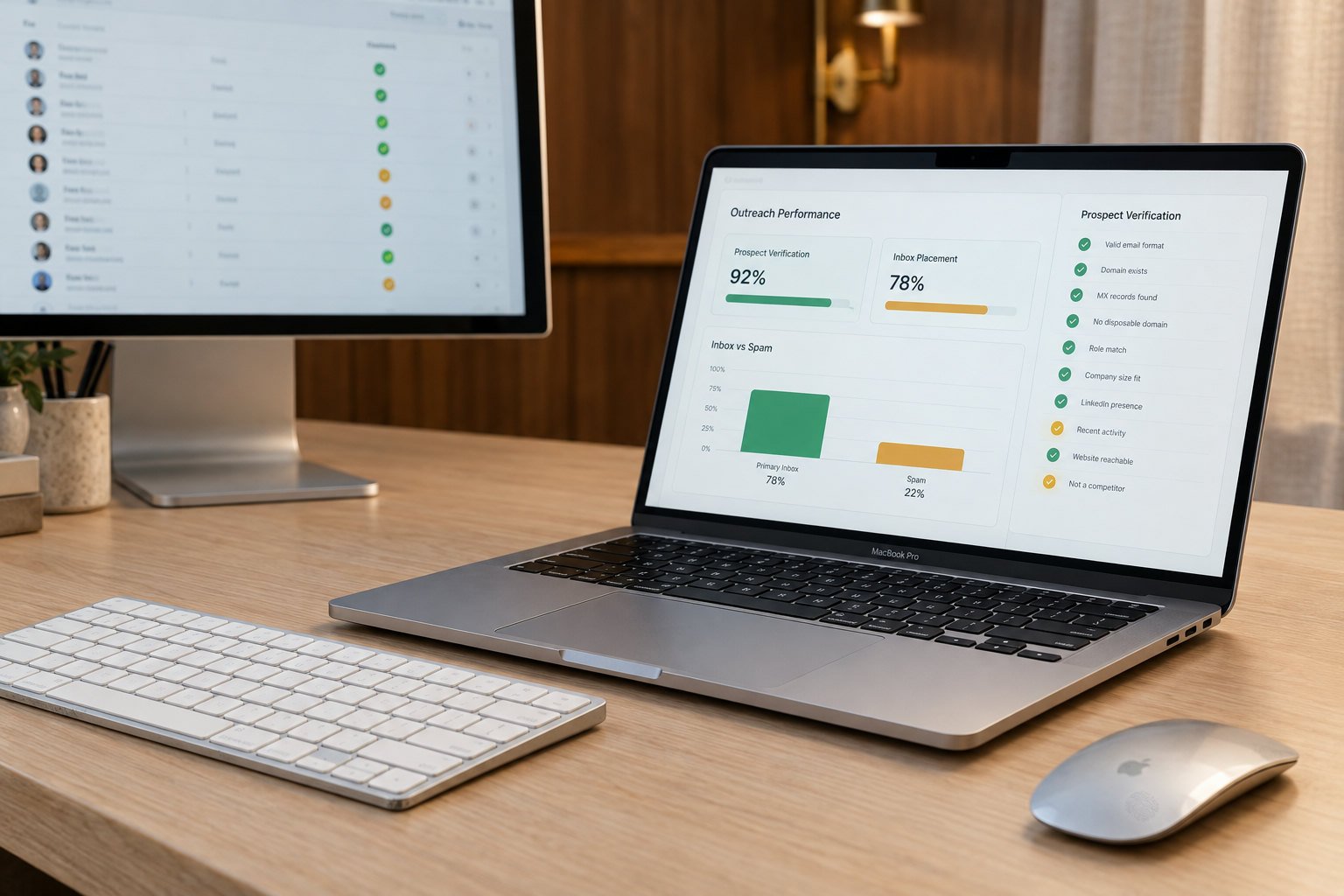
Always verify email addresses before sending. Bounce rates above 3% damage your sender reputation and reduce inbox placement rates. Use email verification tools to confirm deliverability before launching your campaign.
For enterprise-level lead generation services, providers typically combine multiple data sources, verify all contact information, and segment lists by priority level, ensuring only the highest-quality prospects receive initial outreach.
List Segmentation for Better Results
Don’t send the same email to every prospect on your list. Segment by company size, industry, or role and create variations of your script.
A VP of Sales at a 50-person startup has different pain points than a VP of Sales at a 500-person enterprise. Tailoring your messaging to each segment increases response rates by 25-35%.
Setting Up Your Email Sending Infrastructure
Technical infrastructure matters enormously for cold email success. Without proper sending infrastructure, your emails end up in spam folders, and your reputation tanks.
Email service providers (ESPs) used for legitimate marketing (Mailchimp, ConvertKit, ActiveCampaign) will suspend or ban accounts using cold email outreach. You need infrastructure specifically designed for high-volume prospecting.
Essential Infrastructure Components
Dedicated Sending Domain: Use a professional email domain that matches your company. Using free email addresses (Gmail, Outlook) dramatically reduces deliverability and professionalism.
SPF, DKIM, and DMARC Records: Configure these DNS authentication records properly. They prove you own the domain and significantly improve inbox placement rates. Improper configuration results in 40-60% of emails going to spam.
Warming Strategy: New sending domains have no reputation. Before launching full-scale campaigns, gradually increase sending volume over 1-2 weeks, starting with 20-30 emails daily. This “warms” your domain and domain authority.
Cold Email ESP Platform: Use platforms designed for sales prospecting like Salesforce, HubSpot, Apollo, or specialized tools like Lemlist, Outreach, or Instantly. These platforms maintain sender reputation, handle unsubscribes, and track engagement properly.
Reply Management System: Set up dedicated mailboxes to receive and manage responses. Most prospecting tools integrate with Gmail or Outlook, but some teams use dedicated response management platforms like HubSpot or Salesforce to ensure no replies slip through the cracks.
Launching and Testing Your Cold Email Campaign
A successful cold email campaign isn’t a single email—it’s a strategic sequence. Most prospects don’t respond to the first email. They need multiple touches at the right intervals before they’re ready to engage.
The Optimal Email Sequence Structure
Email 1 (Initial Outreach): Introduce yourself, establish relevance, and propose a brief conversation. Keep this short and personalized.
Email 2 (Follow-up, 3-4 days later): Acknowledge that your first email may have been missed and add one new piece of value or insight. This isn’t a repeat of Email 1—it’s genuinely new information.
Email 3 (Follow-up, 5-6 days later): Share a brief case study or example of how similar companies have achieved results. Social proof is powerful at this stage.
Email 4 (Follow-up, 7-8 days later): Final attempt with a slightly different angle. Many campaigns stop here, but the highest performers continue.
Email 5 (Follow-up, 10 days later): Last touch offering to help in a different way or asking for referrals. Even if they’re not interested, they might know someone who is.
Campaign Launch Best Practices
Start Small for Testing: Don’t launch to your entire list immediately. Start with 500-1,000 prospects to identify problems before they affect thousands. Track response rates, bounce rates, and unsubscribe rates closely.
Send at Optimal Times: Email timing significantly impacts open rates. Tuesday through Thursday see 40% higher open rates than Monday or Friday. Morning hours (9 AM – 12 PM) outperform afternoon hours. Most ESPs allow scheduling by recipient timezone.
Monitor Deliverability Metrics: Track bounce rates, spam complaints, unsubscribe rates, and return path performance. If bounce rates exceed 3%, pause the campaign and investigate list quality issues.
Implement Feedback Loops: If ISPs flag your emails as spam, they may send abuse notifications. Monitor these and remove problematic addresses immediately.
Managing Responses and Booking Appointments
Getting responses is only half the battle—converting those responses into actual appointments is where many teams fail. Without a systematic process for managing replies, interested prospects fall through the cracks and move to competitors.
Response Management System
Immediate Triage: When a prospect responds, categorize them instantly: interested, maybe later, not interested, or asking a question. This determines next steps.
Interested Prospects: Book them on your calendar immediately. Use Calendly, HubSpot, or your CRM’s native booking functionality. Make it simple and remove friction—a link with two available time slots is more effective than “Let’s find a time.”
Maybe Later Prospects: These folks are interested but timing is off. Set a follow-up task to reach back out in 2-4 weeks. Many of these convert when circumstances change.
Question Responders: Treat questions as engagement signals. Answer thoroughly, provide value, and include a soft CTA to schedule. Many objections or questions are just requests for more information before saying yes.
Not Interested Prospects: Don’t immediately give up. Add them to a long-term nurture sequence sending valuable content monthly. Companies’ situations change—budget opens up, new initiatives launch, and previous objections become irrelevant.
Response rate benchmarks vary by industry, but well-executed campaigns typically see:
- 8-15% response rate from initial outreach
- 15-25% response rate across full sequence
- 3-8% conversion rate from responses to actual meetings
- 15-30% show-up rate for booked meetings
This means a 1,000-prospect cold email campaign typically generates 150-250 responses and 5-20 actual meetings (assuming 33% show-up rate from the 15-30 potential meetings).
Measuring Results and Optimizing Performance
Data-driven optimization separates campaigns generating 5% response rates from those hitting 20%. You must measure the right metrics and test continuously.
Critical Metrics to Track
Open Rate: Percentage of recipients who opened your email. Anything above 25% is good; 35%+ is excellent. Subject line quality drives this metric. If open rates are low, your subject lines need work.
Click-Through Rate: Percentage who clicked a link in your email. Typical CTR ranges from 2-5%. Low CTR suggests unclear value proposition or weak CTA.
Response Rate: Percentage of opens that generate actual replies. Target 8-15% overall. This metric reveals whether your message resonates with the audience.
Bounce Rate: Percentage of undeliverable emails. Stay below 3%. Higher rates indicate list quality issues or sending domain reputation problems.
Unsubscribe Rate: Percentage requesting removal from future emails. Anything under 0.5% is normal. Above 1% suggests messaging misalignment or list quality issues.
Appointment Booking Rate: Percentage of responses resulting in booked calls. Track this separately from response rate. High responses but low bookings means your messaging generates interest but doesn’t convince people to meet.
Show-Up Rate: Percentage of booked appointments where prospects actually join the call. Typical rates are 30-50%. Improve this through reminder emails 48 and 24 hours before the meeting.
Continuous Testing Framework
Run systematic A/B tests on one variable every two weeks:
- Week 1-2: Test Subject Line A vs. Subject Line B
- Week 3-4: Test Opening Approach A vs. Opening Approach B
- Week 5-6: Test Value Statement A vs. Value Statement B
- Week 7-8: Test CTA A vs. CTA B
Once you identify the winning version of each element, combine them into your new control. Then test the next variable against this improved control. Over months, compound improvements create dramatic results.
Work with experienced teams who handle this testing systematically. Professional lead generation providers typically manage these optimizations as part of their service, conducting multivariate testing and continuously improving campaign performance.
Frequently Asked Questions
How Many Emails Should I Send Per Day to Avoid Spam Filters?
New sending domains should warm up slowly, starting with 20-30 emails per day for the first week, then increasing by 50-100 daily. Established domains with good reputation can send 300-500+ per day. The key metric is bounce rate and complaint rate—if these stay below 0.5% each, you can increase volume. Most ESPs automatically throttle sends to protect your reputation.
What’s the Difference Between Cold Email and Email Marketing?
Cold email targets unknown prospects who haven’t opted in, focuses on personalization and specific value props, and typically has lower volume but higher engagement. Email marketing targets existing subscribers or customers, focuses on building relationships and nurturing leads, and handles higher volumes. Cold email requires specialized infrastructure and techniques; traditional email marketing tools will suspend or ban accounts using cold outreach techniques.
How Long Does It Take to See Results From Cold Email Automation?
Initial results appear within the first 3-5 days as early responses come in. However, the full sequence takes 3-4 weeks to complete. Meaningful pattern data requires running campaigns for 6-8 weeks minimum to identify optimization opportunities. Most campaigns take 60-90 days to reach optimal performance as you test and refine based on real data.
Is It Better to Use a Cold Email Agency or Build This In-House?
In-house gives you control and direct management but requires hiring specialized talent, building infrastructure, and investing 3-6 months in setup and learning. Agencies provide immediate expertise, existing infrastructure, and proven processes but less direct control and require vetting the right partner. For most businesses, agencies deliver better results faster, especially when they have 10+ years of experience and use tools like Salesforce, HubSpot, and Apollo at an expert level.
Conclusion: The Future of Sales Appointments is Automated
Cold email automation isn’t a growth hack or temporary tactic—it’s the modern foundation of predictable B2B sales. When executed properly, it fills your pipeline with qualified prospects consistently, month after month, without requiring your sales team to spend hours on manual outreach.
The companies winning in 2024 and beyond understand that booking sales appointments using cold email automation requires three aligned components: precise targeting based on detailed ICPs, compelling copy tested through systematic A/B testing, and infrastructure designed specifically for high-volume prospecting.
You don’t have to build this alone. Professional cold email services handle the entire process—from deep-diving into your business and building ICPs, to creating email scripts, sourcing lead lists, managing sending infrastructure, running A/B tests, and booking appointments directly on your calendar. With 10+ years of expertise navigating complex sales operations and mastery of tools like Salesforce, HubSpot, and Apollo, experienced providers can typically begin generating results within 4-6 weeks.
The question isn’t whether to implement cold email automation—it’s whether you’ll do it in-house or leverage expert guidance to accelerate results. Either way, systematizing this process will be one of your highest-impact business decisions this year.

- How To Generate B2B Sales Appointments on Autopilot With Cold Email Outreach
- How to Write Cold Email Scripts That Convert Prospects Into Sales Appointments
- How Best Leads Builds Cold Email Systems That Generate B2B Sales Appointments on Autopilot
- How to Get B2B Sales Appointments on Autopilot with Cold Email Systems
- How to Get B2B Sales Meetings Booked Directly on Your Calendar With Cold Email Outreach
This article was drafted with AI assistance to ensure factual accuracy.