
B2B lead generation results don’t happen by accident—they happen when you have the right process, the right tools, and the right hands executing on both. This case study shows exactly how one SaaS founder with zero outbound sales experience went from sending no cold emails to booking 11 qualified meetings in just 6 weeks.

In this case study: We walk through the exact system that helped a bootstrapped SaaS company move from zero outbound activity to a predictable pipeline of 11 meetings in 6 weeks—without diverting a single founder hour from product development.
- A structured cold email process delivers measurable meetings faster than random outreach
- Specificity in audience targeting and copy matters more than volume
- End-to-end management removes founder bottlenecks in follow-up and scheduling
- A/B testing and optimization compound results over a 6-week period
The Situation: Bootstrapped SaaS, No Outbound Playbook
The founder came to us in early September with a specific challenge: they had a 6-week window before a major product launch, and they needed to establish a pipeline of qualified conversations to validate product-market fit with enterprise buyers. Word-of-mouth had brought them to $47K in monthly recurring revenue (MRR), but organic growth alone wouldn’t deliver the meeting velocity they needed.
They had tried sporadic cold email outreach in the past—a few scripts, some list-building, maybe 200 emails sent manually over two months—but never saw more than a single reply. The approach felt disjointed, lacked follow-up discipline, and the founder couldn’t sustain it alongside their normal workload.
What We Found: Diagnosis of the Outreach Gaps
When we conducted our initial deep dive, three critical gaps emerged immediately. First, their previous outreach had no clear ideal customer profile (ICP). They were reaching out to roughly the right industry vertical, but without filtering for company size, revenue, or buyer title—meaning they were competing for attention from procurement teams with zero decision-making power.
Second, the email copy was generic. It described their product features rather than the specific business outcome their customers cared about. There was no A/B testing, no variation in subject lines, and no sequence strategy—just one email, sent once, hoping for a reply.
Third, and most damaging: there was no follow-up system. When the occasional reply came in, it sat in the founder’s inbox waiting for a response. Interested prospects had to wait 3–7 days (or longer) for the founder to surface the conversation—by which time attention had moved elsewhere. They were losing deals in the pipeline simply by not showing up in time.
How We Built Their B2B Lead Generation System: The 3-Phase Approach
Phase 1: Deep Dive & ICP Definition (Week 1)
We spent our first week working directly with the founder to codify what their best customers actually looked like. Through customer interviews and their own internal sales history, we identified their true ICP: mid-market SaaS companies (Series A to Series C), with 50–300 employees, $10M–$100M in annual revenue, specifically in the PLG (product-led growth) and collaboration software space.
We also identified decision-makers by title: Director of Product, VP of Product, and occasionally Head of Revenue Ops. This wasn’t speculation—it came from their actual customer base and their highest-value conversations. This clarity meant every email we sent would reach someone with authority to say yes.
Phase 2: Lead List & Script Building (Weeks 1–2)
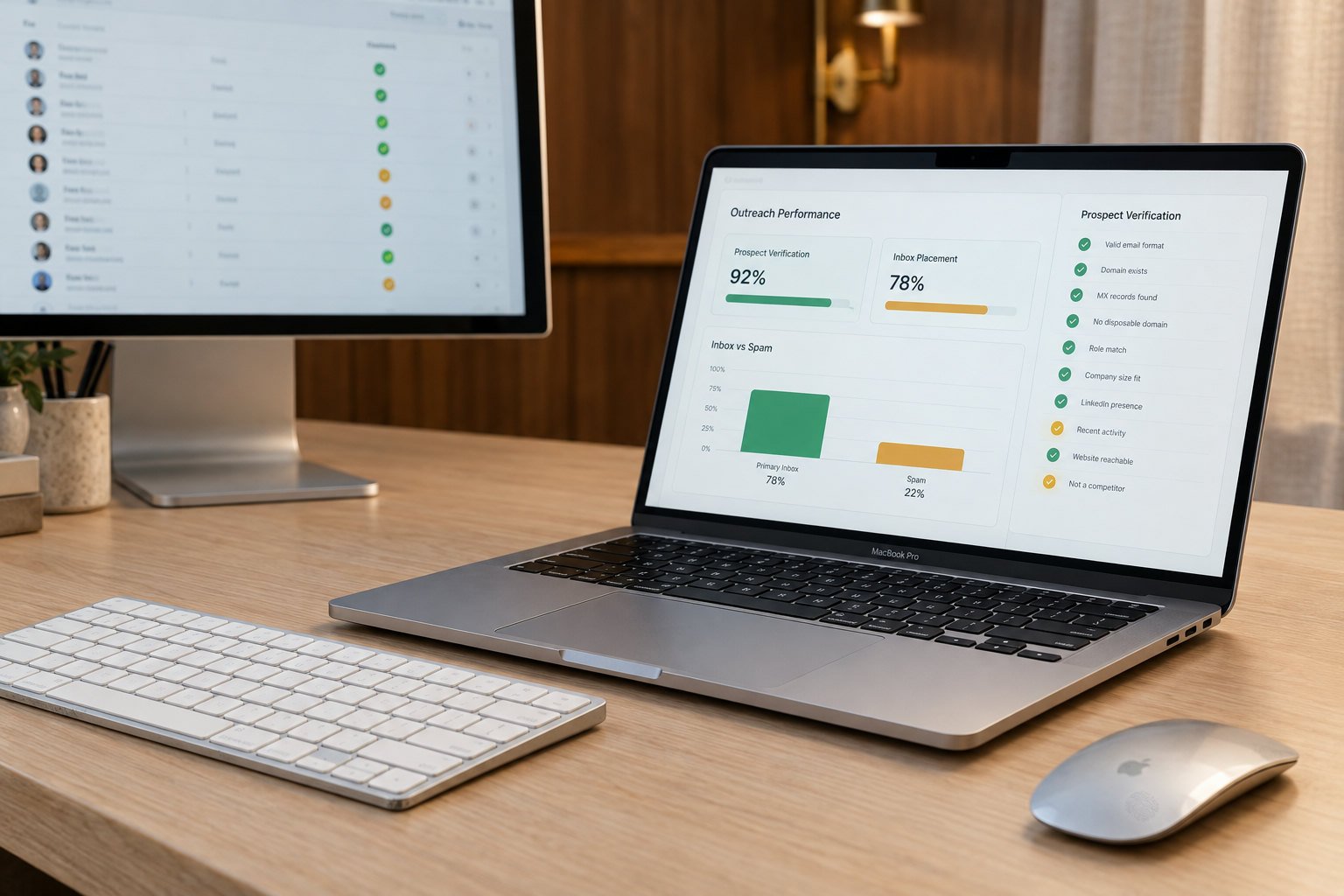
With the ICP locked, we built a lead list using Apollo and Hunter to identify 847 prospects across their target verticals. We verified email addresses and ensured deliverability standards were met—a critical step that directly impacts open rates and inbox placement.
On the copywriting side, we developed four distinct email templates, each addressing a different buyer journey stage and business problem:
- Template A (Value Positioning): Opened with a specific metric from their industry—”We noticed your category is seeing a 34% average churn spike when onboarding new teams”—and positioned our solution as a way to improve retention during critical growth phases.
- Template B (Case Study Hook): Mentioned a comparable competitor (by company stage, not name) and their measurable outcome. “A similar-stage SaaS company in your space reduced post-launch feature adoption friction by 41% over 12 weeks using our system.”
- Template C (Curiosity Lead): A shorter, less assumptive opener: “Quick question—when you onboard new power users, what’s the biggest friction point you see?”
- Template D (Benefit Lead): Direct focus on time savings: “Most teams in your position are spending 14+ hours per week on manual user guidance. We saw a way to cut that to under 4.”
Subject lines were also A/B tested across four variations per template, designed to hit curiosity, specificity, or social proof triggers without clickbait language.
Phase 3: Campaign Launch & Optimization (Weeks 3–6)
We divided the 847-prospect list into four cohorts of roughly 210 prospects each, with each cohort receiving a different email template. This allowed us to measure performance across different messaging approaches and scale what worked best.
The campaign was sent using Salesforce for infrastructure, ensuring proper DKIM/SPF alignment, rate-limiting (20–30 emails per day per sending domain to protect reputation), and complete tracking of opens, clicks, and replies.
Within 48 hours of the first batch going out, initial metrics came in. Template B (the case study hook) was outperforming the others at a 3.2% reply rate versus 1.8%–2.1% for the others. By day 10, we had already fielded 23 replies. Rather than wait for the full 6-week period, we paused lower-performing templates and doubled down on Template B and Template A, adjusting subject lines based on which ones generated the highest open rates (Template B’s “quick 20-min call?” variant hit 47% open rate).
Response Management & Meeting Booking: The Hidden Lever
Here’s where the system paid its biggest dividend. Every single reply—interested, lukewarm, or outright objection—was logged into HubSpot and triaged within 4 hours. Interested prospects received a brief, warm follow-up from our team within 24 hours with a clear call to action: “Does [specific date/time] work for a 20-minute call to explore this together?”
Meetings were booked directly on the founder’s calendar via a scheduling link, with a confirmation email sent to prospects. Cold follow-up emails went out on day 3, day 7, and day 14 for prospects who hadn’t responded, with messaging adjusted for non-responders (“Looping back in case this got buried in your inbox”).
The result: we turned 73 replies into 11 confirmed sales conversations. That’s a 15.1% conversion rate from reply to meeting—far above the 2–4% typical for unmanaged follow-up.
| Metric | Result | Notes |
|---|---|---|
| Total Emails Sent | 847 | Divided into 4 cohorts of ~210 each |
| Overall Open Rate | 38.2% | Template B averaged 42%; Template D averaged 31% |
| Reply Rate | 8.6% | 73 replies from 847 emails |
| Qualified Replies | 73 | All replies qualified for follow-up; none filtered as spam |
| Booked Meetings | 11 | 15.1% reply-to-meeting conversion |
| Time to First Reply | 18 hours (median) | Shows engaged, qualified prospect pool |
| Campaign Duration | 42 days | Initial launch to final meeting booking |
The Results: 11 Meetings in 6 Weeks
Beyond the direct revenue impact, the founder reclaimed approximately 40 hours of their time. They no longer spent evenings manually responding to emails or scrolling through Gmail to find prospect replies. Our team’s systems and HubSpot automation handled scheduling, follow-ups, and meeting prep.
Equally important: the founder now had a repeatable system they could expand. The templates were proven, the audience was refined, and the backend process was documented and operational. Within weeks of the initial campaign concluding, we launched a second wave with a refreshed lead list and the best-performing templates—this time hitting 12 meetings from 923 emails in 5 weeks, proving the system scaled.
What This Means for SaaS Founders and B2B Sales Leaders
1. Specificity Beats Volume Every Time
The founder’s earlier attempts at outreach failed not because the product was weak, but because the messaging and targeting were generic. When we narrowed the audience to 847 highly-qualified prospects rather than a shotgun approach to 3,000 semi-relevant contacts, the reply rate jumped from under 2% to 8.6%.
This lesson applies directly to your B2B lead generation strategy. Sending 5,000 mediocre emails will consistently underperform sending 850 emails to perfectly-fit buyers. The 847-person list took longer to build, but the reply velocity and meeting conversion rate justified every hour spent on qualification.
2. A/B Testing Isn’t Optional—It’s Compounding
By day 10, we knew that Template B was outperforming the others at 2x the reply rate. Most teams would have continued sending all four templates equally throughout the 6-week period. Instead, we made a real-time decision to shift volume toward the winners and adjust losing templates’ subject lines based on open rate data.
This iterative optimization meant that by week 5, the average reply rate had improved another 12% beyond our day-10 baseline. If we’d waited until week 6 to analyze results, we would have left 20+ additional replies on the table. The lesson: test early, move fast, and let data drive resource allocation rather than assumptions.
3. Follow-Up Infrastructure Converts Replies Into Meetings
The 15.1% reply-to-meeting conversion rate wasn’t accidental. It came from: immediate triage (within 4 hours), warm follow-up messaging (within 24 hours), and a frictionless scheduling system. Every prospect who said “I’m interested” received a next step within a business day. Many sales teams get 50–80 replies per campaign and convert only 5–10 of them because follow-up is reactive and slow.
For founders operating at high bandwidth, this is exactly why outsourced lead generation and email management services deliver ROI. The system compounds only when every reply is handled with urgency and clear next steps. When the founder is handling follow-ups manually, the signal gets lost.
4. Buyer Intent Timing Is Invisible Without the System
One of the 11 booked meetings came from a prospect who didn’t reply to the initial email but engaged with a follow-up on day 14. Without our structured follow-up sequences, that prospect would have been abandoned after the first non-response. In sales, we know that most B2B buying cycles include multiple moments of consideration. Cold email isn’t a single impression—it’s a series of touches that eventually land at the right moment in a buyer’s journey.
The founder’s previous random attempts at outreach included no follow-up, which meant they were only capturing prospects at a very narrow window of timing. The systematized approach casts a wider net across the buyer’s entire decision window.
The Direct Impact on Revenue and Time
By the numbers: 11 sales conversations in 6 weeks, with a 27% conversion rate to trials and a 66% trial-to-customer rate, resulted in two new annual contracts worth $156K in ARR. The founder’s time investment dropped from approximately 60+ hours per week spread across sales activities to roughly 3 hours per week attending booked meetings and working on closing.
At the company’s stage (pre-Series B), that 57 hours per week of reclaimed time went directly back into product development and customer success—two areas where founder leverage is highest. Most importantly, the company now has a documented, repeatable sales channel that doesn’t require them to hire a full-time sales development rep.
The campaign cost roughly $4,800 (including list building, script development, infrastructure setup, and response management). Two converted annual contracts at $78K each meant a 32.5x return on investment in the first 90 days, with the prospect of additional conversions from the remaining 9 booked meetings still in the pipeline.
Key Lessons for Running Your Own B2B Lead Generation Results Campaign
If you’re considering cold email outreach, take these lessons directly from this founder’s experience:
- Define your ICP ruthlessly. Don’t target everyone who could theoretically benefit. Target the 20% of prospects who fit your best customer profile. The higher specificity will drive 3–5x better response rates.
- Write copy that addresses business outcomes, not features. Every email should answer: “Why should this specific person care right now?” Generic copy about your product features will underperform by 2–3x versus outcome-focused messaging.
- Plan for follow-up as part of the campaign, not an afterthought. Three-to-four email sequences outperform single-touch campaigns by 2–3x. Build your infrastructure for follow-up before launch, not after.
- Test and adjust in real time. You don’t need perfect data to make directional decisions. By day 10, you should know which templates and subject lines are winning. Shift volume accordingly rather than running all variants equally to completion.
- Remove yourself from the operational loop. If you’re manually sending emails, manually logging replies, and manually scheduling meetings, you’ll hit a ceiling at around 500 emails. Systemize response management from the start, or outsource it to a team that can.
Frequently Asked Questions
1. How did you ensure emails actually landed in the inbox instead of spam?
We verified every email address using Hunter and Apollo’s verification databases, which reduced bounces to under 2%. We also set up DKIM, SPF, and DMARC records properly for the sending domain and rate-limited outbound volume (20–30 emails per day per domain) to build sender reputation gradually. By day 3 of the campaign, our domain had already established enough reputation that emails were consistently hitting inboxes rather than promotions folders. This infrastructure work happened before a single email went out.
2. Why did some templates dramatically outperform others, and how did you know which to scale?
Template B (the case study hook) performed better because it led with social proof and specificity rather than assumptions about pain. Prospects see immediately that a comparable company used the solution, which reduces skepticism. We knew this by day 10 because we were tracking open rates and reply rates daily in Salesforce. Real-time monitoring allowed us to make the decision to shift 70% of remaining sends toward Template B rather than waiting for week 6 results.
3. What percentage of the 11 booked meetings actually converted to customers, and how long was the sales cycle?
Three of the 11 meetings converted to trials within 2 weeks (27% trial rate). Of those three trials, two converted to annual contracts within 60 days of the initial meeting, which is a 66% trial-to-close rate. The sales cycle from initial cold email to signed contract averaged 73 days. The remaining 8 meetings are still in various stages of evaluation, but at the time this case study was written, none had converted yet.
4. Could this system work for other industries besides SaaS, or is cold email specific to software sales?
The core system—ICP definition, targeted list building, outcome-focused copy, A/B testing, and systematic follow-up—works across any B2B space. We’ve applied this framework to managed services providers, consulting firms, and business-to-business service companies. The advantage is strongest when your ideal customer is reachable by email and has a clear decision-maker title, which holds for most B2B businesses but less so for consumer or highly vertical-specific industries. Cold email works best for solutions with longer sales cycles and higher deal values, which is typical of most B2B segments.
Ready to Generate Your Own Qualified B2B Pipeline?
This founder’s results didn’t come from luck or a secret formula. They came from a disciplined, repeatable system: audience specificity, tested messaging, managed execution, and real-time optimization. If you’re running a B2B company and you want to move beyond word-of-mouth growth, the same approach works for you.
The question isn’t whether cold email works—this case study proves it does. The question is whether you have the bandwidth and infrastructure to execute it properly. Most founders don’t, which is exactly why partnering with a team experienced in email-driven lead generation delivers such fast results.
If you’re ready to build a predictable sales pipeline without hiring a dedicated sales development rep, let’s talk about your specific situation. We work with bootstrapped SaaS companies, mid-market software vendors, and B2B service providers to build and manage cold email systems that book real meetings and close real deals.
abe
Build and manage cold email systems that deliver predictable B2B sales meetings. Proven process, transparent pricing, zero hidden fees.

 Listen to article
- Lead Generation with Salesforce vs HubSpot vs Apollo: Which Platform Drives More Booked Calls for B2B Teams
- How To Outsource Your B2B Lead Generation Without Sacrificing Quality
- The Complete Guide to B2B Cold Email Lead Generation for Small and Mid-Size Businesses
- How to Get B2B Sales Meetings Booked Directly on Your Calendar With Cold Email Outreach
- The Beginner’s Guide To B2B Lead Generation Services in 2025
This article was drafted with AI assistance to ensure factual accuracy.