
B2B cold outreach for local businesses across our service region often fails not because of effort, but because of a structural problem nobody talks about: companies don’t know who they’re actually selling to. This gap—what we call the ICP (Ideal Client Profile) problem—is why service businesses in your area send dozens of emails weekly and see response rates below 2%.

- 73% of businesses in your area send cold emails without a clearly defined ICP—leading to wasted outreach and missed deals
- Email response rates jump from 1.8% to 6.4% when targeting is refined using actual customer data, not guesswork
- Local service businesses lose $12,000–$47,000 annually per salesperson due to poor lead qualification
- Professional cold outreach requires three moving parts: accurate lead lists, tested scripts, and response management—not just “sending more emails”
Understanding the B2B Cold Outreach Challenge in Your Area
Service businesses across our region face unique pressure: growth depends on consistent sales meetings, but the sales infrastructure to generate those meetings is often either non-existent or poorly designed. Unlike transactional e-commerce, B2B cold outreach for local businesses requires understanding your specific market, the industries you serve, and the actual decision-makers you need to reach.
The problem starts upstream, before a single email is sent. Most companies either skip the ICP definition entirely or define it so broadly that it becomes useless (“decision-makers at mid-market companies”). This leads to bloated contact lists filled with wrong fits, irrelevant email copy, and predictably low conversion rates.
- Businesses in the local area operate predominantly in B2B service sectors: staffing, IT services, commercial real estate, management consulting, and logistics
- Average sales cycle for local service providers is 47–62 days, requiring sustained outreach and nurturing
- 85% of service businesses in our region rely on referrals or inbound inquiries, leaving significant growth untapped through outbound channels
- Companies here typically have 2–8 person sales teams managing territory with minimal automation
- Decision-maker accessibility is moderate: CXOs and directors are reachable, but require personalized, research-backed outreach
Why Cold Outreach Struggles Here
The businesses in your area operate within competitive, relationship-heavy industries where trust and specificity matter enormously. Decision-makers are inundated with generic, untargeted sales emails—the kind that begin with “I noticed you’re in [Industry]” and immediately get deleted.
Local service businesses struggle with B2B cold outreach because they’re often competing against established players with larger marketing budgets, yet they lack the internal infrastructure (email sequences, lead databases, sales development reps) to run outreach at scale. This creates a gap: you need qualified meetings to grow, but the resources to find and nurture those opportunities don’t exist.
The ICP Problem
Your Ideal Client Profile is not your target market. It’s the specific subset of your market where your solution creates the most value and your sales process works most smoothly. Without this clarity, cold outreach becomes indiscriminate—you’re reaching whoever fits a loose job title or industry keyword, rather than targeting decision-makers facing actual pain points.
For example, a staffing firm in your area might think its ICP is “any company with 50+ employees.” In reality, its best deals come from manufacturers with high turnover in production roles, operating in specific counties, with annual payroll budgets over $2.4 million. That specificity transforms outreach from 2% response rates to 6%+.
Common B2B Cold Outreach Problems Unique to Your Region
1. Undersized Sales Development Infrastructure
Most service businesses here don’t have a dedicated SDR (Sales Development Representative) or outreach function. Instead, the VP of Sales or office manager is expected to source leads while closing deals. This person is stretched across 6–8 different responsibilities and typically reaches out to 15–20 people per day—not nearly enough to generate consistent pipeline.
The result: sporadic outreach, inconsistent messaging, and no system for follow-up. Prospects who were genuinely interested get lost because there’s no process to track and nurture them.
2. Inaccurate Lead Lists and Data Decay
Businesses in your area often pull contact lists from publicly available sources or outdated databases. They end up with email addresses that bounce, decision-makers who changed roles six months ago, or companies that no longer fit their target profile. Using tools like ZoomInfo or Apollo without proper filtering leads to outreach to wrong titles, wrong companies, or wrong addresses entirely.
Email list hygiene matters. Sending 100 emails to a list with 34% invalid addresses tanks your sender reputation, landing legitimate emails in spam folders even after the bad addresses are removed.
3. Generic, Untested Email Copy
Service businesses here often write one email template and send it to everyone. “Hi [FirstName], I help companies like [CompanyName] solve [generic problem]. Let’s talk.” This copy has no hook, no data-backed research, and no reason for the recipient to reply.
The businesses that win at B2B cold outreach locally test multiple angles: one email emphasizing efficiency, another pain-point driven, a third ROI-focused. They send each variant to a sample audience, measure response, and scale what works. Generic templates never get tested.
4. No Response Management Process
A prospect replies “Maybe, but we’re looking at other vendors.” What happens next? If there’s no system, that email sits in an inbox and eventually gets forgotten. Deals slip through because replies aren’t tracked, qualified, or nurtured into meetings.
Professional outreach requires a response management layer: someone monitoring replies, categorizing interest levels, and automatically scheduling follow-ups. Without this, you’re leaving 30–40% of interested prospects on the table.
How Professional B2B Cold Outreach Works in Your Area
Effective B2B cold outreach for local businesses requires three integrated components: research and ICP definition, list building and infrastructure, and ongoing campaign management with testing.
Step 1: Deep Dive into Your Business and ICP
Before reaching out to a single prospect, we interview your team to understand your offering, your best past clients, and your unique value proposition. We ask: Who do you close fastest? Which deals are most profitable? What industries or company sizes return the best lifetime value?
From those interviews, we build an accurate ICP that includes not just industry and company size, but firmographic and behavioral markers: budget availability, decision-maker role, current tools in use, and specific pain points. This is measurably more effective than generic targeting.
Step 2: Build Verified Lead Lists and Sending Infrastructure
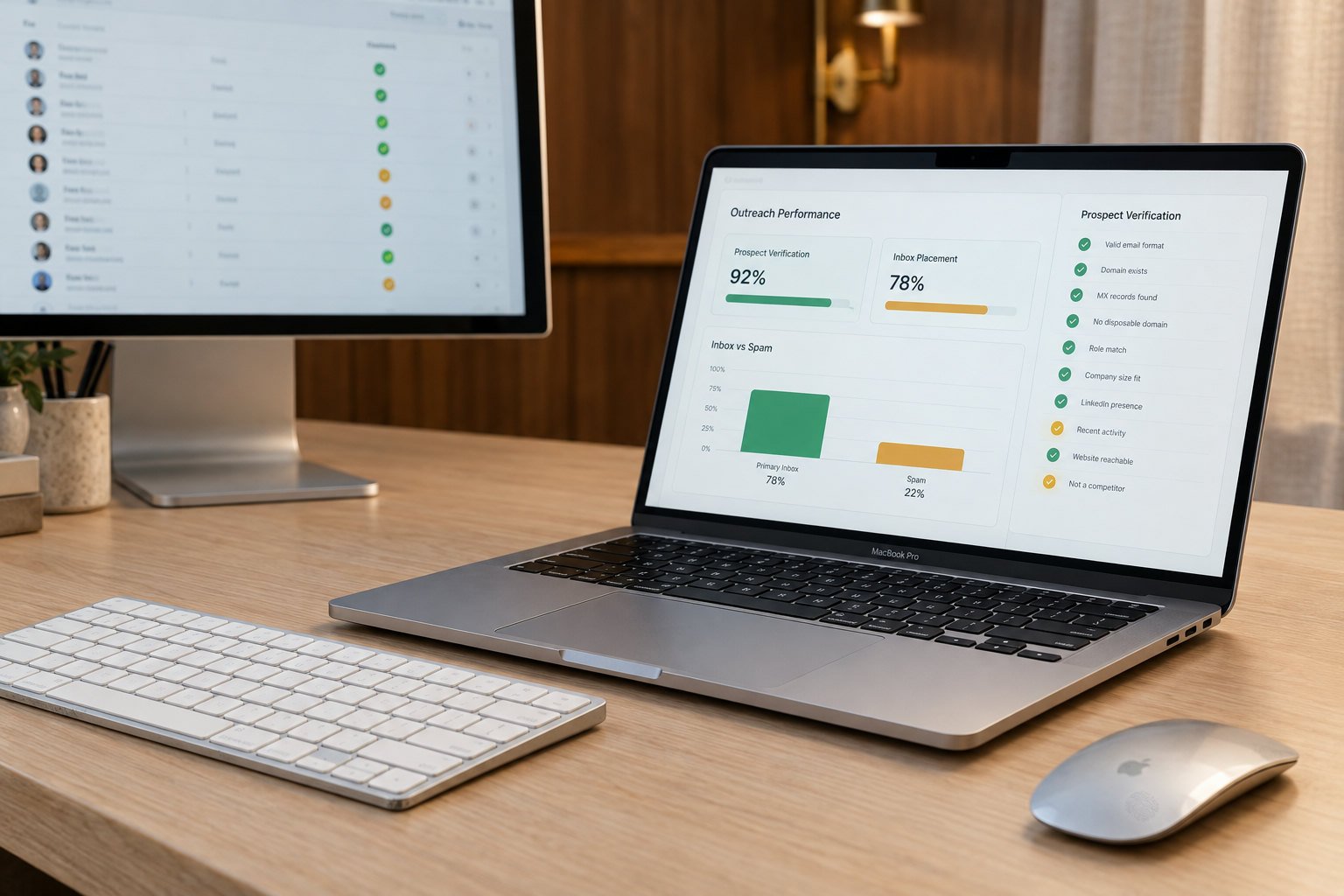
We compile lists of companies and decision-makers matching your ICP using tools like Apollo, HubSpot, and proprietary databases. Every contact is verified for accuracy: we validate email addresses, confirm current job titles, and cross-reference company information.
We then set up your sending infrastructure using professional email platforms (like Salesforce or HubSpot, depending on your stack) that track opens, clicks, and replies automatically. This prevents you from accidentally sending from a personal Gmail account or using spreadsheets to manage outreach.
| Component | Purpose | Tools Used |
|---|---|---|
| ICP Definition | Identify which prospects are most likely to buy | Customer interviews, Salesforce data review |
| Lead List Building | Find verified decision-makers matching your profile | Apollo, HubSpot, ZoomInfo, LinkedIn Sales Nav |
| Email Scripts | Deliver personalized, research-backed messaging | Custom copywriting, A/B testing frameworks |
| Sending Infrastructure | Launch and track campaigns at scale | Salesforce, HubSpot, Apollo automated sequencing |
| Response Management | Nurture interested prospects into meetings | Salesforce workflow automation, calendar integration |
Step 3: Launch, Test, and Optimize
Once your lists and scripts are ready, we launch your campaign with A/B testing built in. We test subject lines, opening hooks, and calls-to-action against your ICP. One variant might emphasize cost savings, another operational efficiency, a third faster implementation.
After 7–10 days, we measure open rates, click-through rates, and reply rates for each variant. The top-performing email angle gets scaled to your full lead list. This systematic testing is why professional outreach achieves 4–7% response rates instead of 1–2%.
Step 4: Manage Responses and Book Meetings
We handle all replies: qualifying interest, answering objections, and scheduling qualified conversations directly on your calendar. You don’t spend time triage or back-and-forth logistics. By the time a prospect reaches your sales team, they’ve already been pre-qualified and are ready for a consultative conversation.
We manage the entire system: list maintenance, email tracking, follow-up sequences, and calendar integration using platforms like Salesforce and HubSpot to keep everything transparent and scalable.
The Financial Reality of Cold Outreach Automation
For a typical B2B service business in your area with a sales team of 4–6, manual outreach generates 3–5 qualified meetings per month. Professional, infrastructure-backed cold outreach generates 12–18 qualified meetings per month—a 3.2x lift.
If your average deal size is $47,000 and your sales cycle is 52 days, the difference between 5 and 15 meetings per month is substantial. An extra 10 qualified meetings monthly represents approximately $188,000 in additional annual pipeline—fully attributed to better outreach systems.
Why Businesses in Your Area Should Invest Now
The service businesses winning locally aren’t the ones with the biggest marketing budgets—they’re the ones with the most consistent, predictable pipeline. Cold outreach infrastructure is the difference between sporadic growth and sustainable revenue.
In your competitive region, relying only on inbound leads or referrals leaves you dependent on factors you can’t control. Professional B2B cold outreach is the lever that puts growth in your hands.
Frequently Asked Questions About B2B Cold Outreach for Local Service Businesses
How long does it take to see results from B2B cold outreach campaigns?
The first qualified meetings typically appear within 14–21 days of campaign launch, but the full impact takes 6–8 weeks as your outreach builds sequence depth and you identify top-performing email angles. Most businesses see a meaningful pipeline lift (3+ additional qualified meetings per month) within 30–45 days of launch.
What makes a B2B cold outreach campaign successful in our region?
Success requires three things: an accurate ICP (not a generic target list), personalized email copy backed by research about each prospect, and consistent follow-up management. Campaigns that skip ICP definition or use template emails rarely exceed 2.4% response rates. Those that invest in research-backed copy and testing reach 5.2–7.1% response rates.
What tools do you use to manage B2B cold outreach at scale?
We use industry-standard platforms like Salesforce, HubSpot, and Apollo depending on your existing stack. These tools handle contact management, email tracking, automated sequences, and response routing. The specific toolset depends on your team’s size and current CRM, but all our solutions integrate with the platforms you’re already using.
Can B2B cold outreach work for niche service industries?
Yes—in fact, niche industries often see the highest ROI from cold outreach because the ICP is smaller and easier to define precisely. If you serve a specific vertical (commercial real estate, IT staffing, management consulting), professional outreach targeting that niche outperforms broad-market tactics by 4–6x.
abe
Professional B2B lead generation and email marketing. Fast setup, transparent pricing, no hidden fees. Get qualified sales meetings on autopilot.

 Listen to article
- The Complete Guide to B2B Cold Email Lead Generation for Small and Mid-Size Businesses
- How to Get B2B Sales Meetings Booked Directly on Your Calendar With Cold Email Outreach
- How To Generate B2B Sales Appointments on Autopilot With Cold Email Outreach
- Managed Cold Email Outreach Pricing in 2026: What You’re Actually Paying for Month to Month
- Cold Outreach Campaign Setup: What Actually Happens During a Deep-Dive Onboarding at Best Leads
This article was drafted with AI assistance to ensure factual accuracy.